Australia has around twenty properties listed as UNESCO World Heritage sites, including natural sites, architectural ensembles, and Indigenous cultural landscapes. Some of these places are recognized for both their natural and cultural values, a dual listing that includes Kakadu, Uluru-Kata Tjuta, and the Tasmanian Wilderness. This layering of classifications reflects how Australian heritage intertwines geology, ecosystems, and millennia-old human narratives.
Convict Sites: An Often Overlooked Australian Heritage
Lists of Australian monuments almost always begin with the Sydney Opera House or the Harbour Bridge. Before discussing contemporary architecture, an entire chapter of the country’s history deserves attention: the Australian Convict Sites, inscribed as a World Heritage site in 2010.
These sites encompass several locations related to the transportation system of British convicts to Australia, a system that operated for several decades and shaped the country’s demographics and culture. They include penitentiaries, barracks, and forced labor camps spread across New South Wales, Tasmania, and Western Australia.
Because they document a foundational and brutal chapter, the famous monuments of Australia are not limited to the icons photographed by tourists. The Convict Sites tell the story of colonization from its margins, through physical constraint and prison organization, long before the country became a democratic federation.
Budj Bim Cultural Landscape: When a Monument is an Aquaculture System
Inscribed as a World Heritage site in 2019, the Budj Bim cultural landscape in the southeast of the country does not resemble any monument in the classical sense. It is an aquaculture system developed by the Gunditjmara people, a network of channels, stone weirs, and ponds designed to trap and farm eels.
This system is considered one of the oldest known forms of aquaculture. Its recognition by UNESCO marked a turning point in how Australian heritage integrates Indigenous knowledge, no longer as a folkloric complement but as a fully-fledged technical heritage.
The significance of Budj Bim also lies in what it reveals about the very notion of a monument. In Australia, a heritage site can be an entire landscape, a hydraulic network, a relationship between a people and a territory. Australian heritage far exceeds the category of a building.
Kakadu and Uluru-Kata Tjuta: Mixed Sites and Indigenous Co-Management
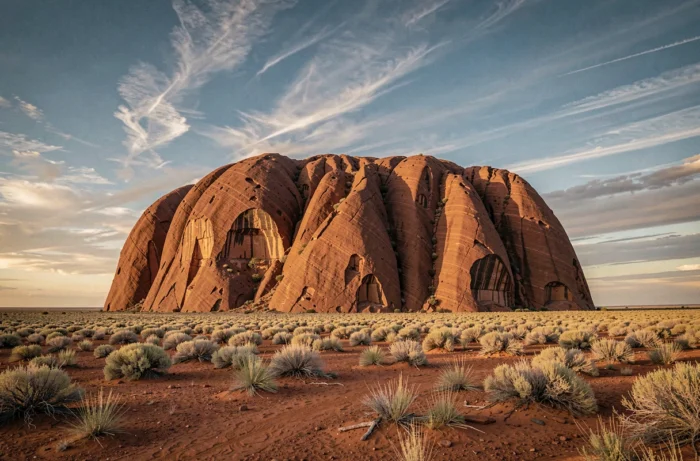
Kakadu and Uluru-Kata Tjuta are among the few sites in the world to benefit from dual UNESCO listing, both natural and cultural. This recognition reflects the presence of remarkable ecosystems and some of the oldest rock art on the planet.
Beyond the classification, it is the management approach of these sites that distinguishes them. The management of Kakadu relies on the knowledge of the traditional owners, the Bininj and Mungguy peoples, who participate in decisions regarding conservation and access. A specific strategy, the Kakadu Sea Country Strategy 2025-2035, has been published to guide the management of the maritime domain associated with the park.
For Uluru-Kata Tjuta, co-management between the Anangu people and the federal administration has led to concrete decisions, such as the ban on climbing Uluru, which has been in effect for several years. This choice, sometimes controversial in tourist circles, illustrates the priority given to the cultural significance of the site over its recreational dimension.
What Dual Listing Means for Visitors
A site listed solely for its natural values is visited like a park. A mixed site demands a different perspective: the rock formations, waterways, and wildlife are inseparable from the stories, rituals, and access rules defined by Indigenous communities.
- Some areas of Kakadu and Uluru-Kata Tjuta are closed to the public for cultural reasons, regardless of weather conditions or visitor numbers.
- Interpretation panels at these sites consistently present the Indigenous perspective, not just the geological or biological reading.
- Photography is prohibited in several sacred areas, a restriction rarely encountered in European or North American national parks.
Sydney Opera House and Harbour Bridge: What Architecture Tells Us About National Ambition
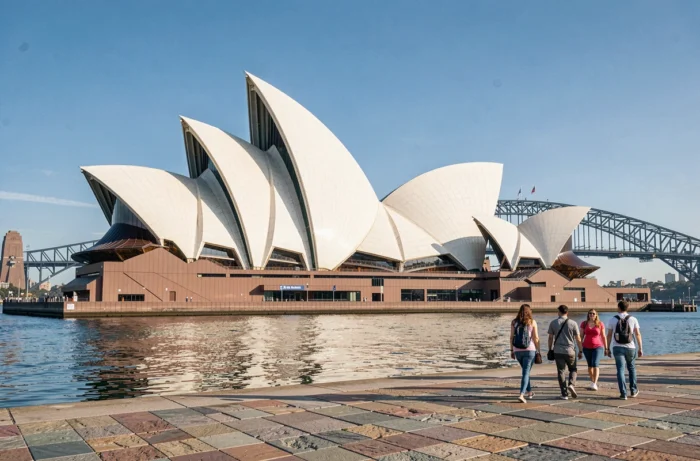
The Sydney Opera House, designed by Danish architect Jørn Utzon after a competition launched in 1956, was inaugurated by Queen Elizabeth in 1973. Its shell-like architecture remains the most widely disseminated image of the country internationally.
The building houses several venues, including the Concert Hall for symphonic concerts and the Joan Sutherland Theatre dedicated to opera and dance. The Sydney Opera House is both a performance venue and a symbol of architectural ambition, at a time when Australia sought to assert its own cultural identity in the face of former colonial powers.
The Sydney Harbour Bridge, inaugurated long before the Opera House, completes this harbor landscape. The two structures form an inseparable visual ensemble, photographed from all angles, but whose significance goes beyond the postcard. They testify to two distinct moments in Australian nation-building: the heavy infrastructure of the 1930s, followed by the cultural boldness of the post-war period.
Melbourne, Canberra, and the Monuments of Political Memory
The Shrine of Remembrance in Melbourne, dedicated to the memory of Australian soldiers, and the Australian War Memorial in Canberra embody another dimension of monumental heritage. These buildings document the place of military experience in national identity.
Parliament House in Canberra, partially buried under a hill, features architecture intended to serve democracy rather than ostentation. Its design has been the subject of prolonged debates on how a public building can express the values of a young country without reproducing the neoclassical codes inherited from Europe.
Australia does not have a millennium-old cathedral or a medieval castle. Its most significant monuments are either very recent in the context of global architectural history or rooted in Indigenous temporalities that span thousands of years. This tension between two time scales remains one of the most distinctive features of Australian heritage.