French households are dedicating an increasing share of their free time to activities practiced within their four walls. The landscape of home entertainment has significantly expanded in recent years, with streaming platforms, booming board games, and creative hobbies reinventing themselves in sensory or customizable formats. This article reviews the major categories of home leisure and the dynamics shaping them in 2026.
Construction Games and Educational Games: The Fastest Growing Category
According to Les Échos Études, sales of construction games are significantly increasing in 2026, and educational games are experiencing strong acceleration according to Circana data. This is no coincidence: these products meet parental demand for screen-free leisure activities while remaining attractive to children.
Construction games (blocks, circuits, models) offer long and repeatable playtime. They engage fine motor skills, spatial planning, and can be played alone or with family. Educational kits, on the other hand, cover a spectrum ranging from scientific puzzles to experimentation sets.
LSA reported in September 2026, based on Christmas trends presented by industry professionals, that board games and creative hobbies remain among the categories that are always attractive for reconnecting parents and children around a shared activity. The available catalogs on the Séries Conseil website illustrate this diversity of offerings, from classic board games to more elaborate craft activities.
Series and Streaming: An Evolving Audiovisual Landscape
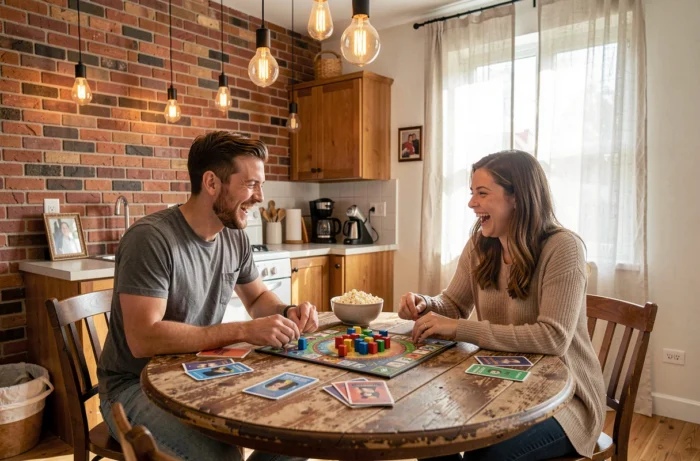
Watching series remains one of the most widespread home leisure activities. However, the offering has become fragmented. According to Télé Satellite et Numérique, which relies on the 2025 Digital Usage Reference from Arcom, households combine free-to-air TV, catch-up services, streaming, and paid packages. Switching from one service to another has become the norm.
This hybridization changes the way we choose a program. The reflex is no longer to turn on a TV set, but to navigate between several applications, which sometimes extends the selection time as much as the viewing time itself.
Online Quizzes and Interactive Experiences
The same article from Télé Satellite et Numérique notes that online quizzes, interactive games, and live experiences complement passive viewing. The TV night of 2026 is no longer solely passive: it incorporates participatory formats, accessible from a smartphone or tablet during the broadcast.
Field feedback varies on this point. Some households fully embrace these hybrid formats, while others perceive them as an additional source of distraction rather than a true leisure activity. The line between watching and playing is becoming blurred, without a clear measure of whether this actually increases viewer satisfaction.
Creative Activities at Home: Sensory and Customizable Formats
Creative hobbies are no longer limited to knitting or painting on canvas. Market data shows an evolution towards more sensory formats: sculptures, slime, creative supplies with variable textures, contemporary embroidery kits. The common thread of these activities is tactile manipulation, contrasting with the omnipresence of screens.
- Embroidery and punch needle attract an adult audience seeking calm concentration, with ready-to-use kits that eliminate the barrier of materials
- Modeling clay and sensory activities target children, but also adults through wellness or relaxation-branded ranges
- Adult coloring books, which emerged several years ago, remain a stable segment, supported by regularly refreshed themed editions
- Customizable creative kits (jewelry, candles, homemade cosmetics) position themselves in the DIY gift market
The quality of materials provided in the kits often determines the duration of engagement. A kit with low-quality supplies discourages after a single use, while a well-designed kit can occupy several evenings.

Board Games with Friends or Family: A Market Driven by Pleasure Purchases
Board games directly benefit from the pleasure purchase dynamic observed in the toy market in 2026. The puzzle, long considered a solitary and somewhat outdated pastime, is experiencing a resurgence of interest, particularly in collaborative or artistic formats.
For evenings with friends, short party games (lasting ten to twenty minutes) coexist with longer strategy games. The choice depends on the group, but also on the available space. A board game requires only a table and adequate lighting, making it an accessible leisure activity without heavy material investment.
Criteria for Choosing a Game Suitable for Your Household
- The number of regular players: some games work for two, while others require a minimum of four participants
- The desired game duration: a quick card game does not serve the same purpose as a two-hour board game
- The age of participants: family board games incorporate simple mechanics, while “expert” games assume a learning curve
The market now offers intermediate ranges, strategic enough to interest adults, yet accessible enough for children as young as eight or nine years old. This intermediate positioning drives sales upward, according to trends noted by industry professionals.
Home entertainment in 2026 is characterized by this coexistence of digital and manual formats, passive and participatory. Market data confirms that the most dynamic categories are those that offer tangible interaction, whether it’s manipulating building pieces, embroidering a pattern, or debating around a game board. Streaming remains dominant in terms of hours viewed, but creative activities and board games are gaining ground where screens are saturating.