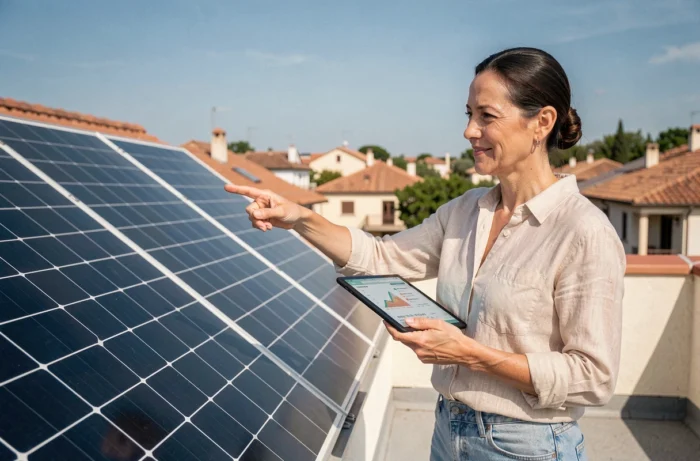
Generating your own solar electricity does not automatically guarantee that your bill will be cut in half. The actual savings depend on a factor that is often underestimated: the share of electricity consumed as it is generated.
In a household where no one is home during the day, that share drops, and the compensation for surplus electricity fed into the grid has fallen sharply for new projects. Comparing optimization strategies (smart controls, batteries, self-consumption without export) helps identify where the real potential for reducing electricity bills lies.
Smart appliance controls, batteries or self-consumption without export: a comparison
Households looking to make greater use of their solar production without relying on selling surplus electricity have three options. Each suits a different occupancy pattern and budget.
| Strategy | How it works | Suitable if no one is home during the day | Additional cost | Impact on self-consumption rate |
|---|---|---|---|---|
| Smart appliance controls | Schedule the washing machine, water heater and dishwasher to run during production hours | Yes, using timers or a solar power diverter | Low (a few hundred euros for a diverter) | Moderate increase |
| Battery storage | Store surplus electricity for use in the evening | Yes, allows consumption to be shifted | High (several thousand euros) | Significant increase |
| Self-consumption without export | No surplus electricity is sent to the grid; requires a specific Enedis agreement | Partially (production is curtailed if no appliances are running) | None to low (inverter curtailment) | Variable, depending on system sizing |
Smart controls are the first step to consider, whatever the system configuration. A solar power diverter automatically redirects surplus electricity to the domestic hot water tank, absorbing a significant share of production without any manual intervention. Specialist resources such as energiesolaires.fr provide details on equipment compatible with this type of energy management.
A battery, meanwhile, addresses the timing mismatch between production and consumption. However, batteries remain uncommon in small residential systems, mainly because of their cost relative to the additional savings they generate compared with basic smart controls.
Solar self-consumption rate: why it determines profitability
The self-consumption rate measures the proportion of solar electricity used directly by the household. The higher this rate, the less the household depends on the grid and the low compensation paid for surplus electricity.
A household occupied during the day (working from home or retired) naturally achieves a higher rate than one where everyone is away from 8 a.m. to 7 p.m. In the latter case, most of the electricity generated is fed into the grid at a purchase rate that covers only a fraction of the price paid per kWh.
This imbalance is precisely what makes smart controls or storage worthwhile. Scheduling the water heater and washing machine to run during sunny hours is often enough to measurably increase the self-consumption rate, with no major investment.
What a solar power diverter does in practice
A solar power diverter monitors the photovoltaic system’s surplus output in real time and directs it to a resistive load, typically the hot water tank. The tank then acts as free thermal storage.
Its advantage over a simple timer is that the diverter responds to actual sunlight rather than a fixed time slot. In cloudy weather, it adjusts the power sent to the tank. In clear weather, it absorbs all the available surplus.
Self-consumption without export: an overlooked option governed by Enedis
Households that do not wish to sell their surplus electricity can request an agreement for self-consumption without export from Enedis. This option requires preventing electricity from being fed into the grid, which means configuring the inverter accordingly or installing a curtailment device.
Simply not signing a sales contract is not enough. Without an agreement or curtailment, surplus electricity is still physically fed into the grid, free of charge.
Who is this option suitable for?
- Households that deliberately install a small system (one or two panels) to cover only their baseload consumption (refrigerator, internet router, standby devices)
- Households looking to avoid all administrative procedures related to selling electricity, including tax reporting requirements
- Property owners in areas where connecting to the grid for export is complicated or expensive
System sizing then becomes critical. An oversized system operating without export wastes surplus electricity that can neither be consumed nor sold. It is better to undersize slightly and increase the self-consumption rate than to oversize and constantly curtail production.

Reduced VAT on solar installations: check the conditions before signing
The reduced VAT rate applicable to solar installations is not automatic. It depends on the system’s capacity, the age of the property and the type of equipment installed. A quote should specify which equipment is covered and whether it meets the eligibility requirements.
In practice, an installer who applies a reduced rate without checking these criteria could expose the customer to a tax reassessment. When reviewing a quote, pay particular attention to three points:
- The system’s peak capacity, which determines eligibility for the reduced rate
- The age of the property (in most cases, it must have been completed more than two years ago)
- Whether the VAT rate applied to each line of the quote is explicitly stated, with equipment and installation listed separately
These checks help avoid unpleasant surprises when the bill arrives or during a later audit.
Residential solar electricity production depends less on the size of the system than on how well production times align with consumption. For a household where no one is home during the day, smart appliance controls offer the best value for money before a battery is considered. Self-consumption without export remains a viable alternative, provided the system is sized accordingly and the household is willing to generate less in order to use more of what it produces.