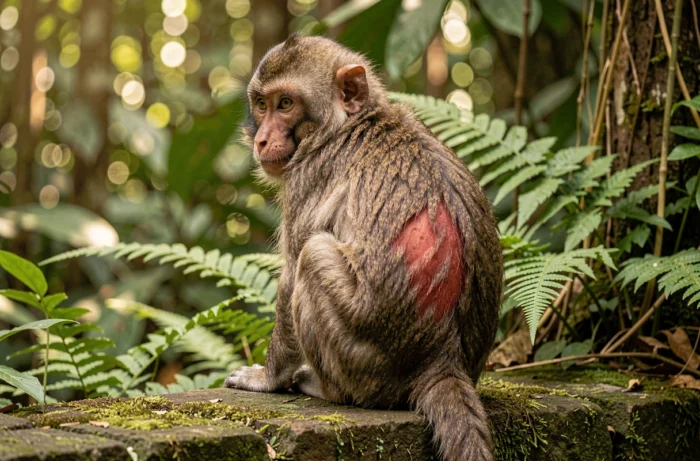
In a viral video, a monkey shows off a bright red rump. Comments debate whether it is a baboon, a rhesus macaque or a “red-bottomed macaque.” That’s where the problem begins: this popular expression does not refer to any specific species. It covers at least two distinct macaques, sometimes confused with baboons, and a photo of the rump alone is not enough to tell them apart.
Identifying the macaque behind the term “red-bottomed monkey”
Search for “red-bottomed macaque” and you’ll find images of rhesus macaques, stump-tailed macaques and even hamadryas baboons. A red rump is a feature shared by several primates, and its appearance varies by species, sex and time of year.
The rhesus macaque (Macaca mulatta) has moderately red skin around the genitals and rump. In females, this area may become redder and swell slightly during the reproductive cycle. The swelling remains subtle compared with that of baboons, whose sitting pads can become much more prominent.
Another possibility is the stump-tailed macaque (Macaca arctoides), sometimes called the red-faced macaque. Its face and rump are permanently red, which is why online searches often label it a “red-bottomed monkey.”
It can be identified first by its very short, almost absent tail and its range in South and Southeast Asia. To learn more about the red-bottomed macaque, distinguishing between these two species is a useful starting point.
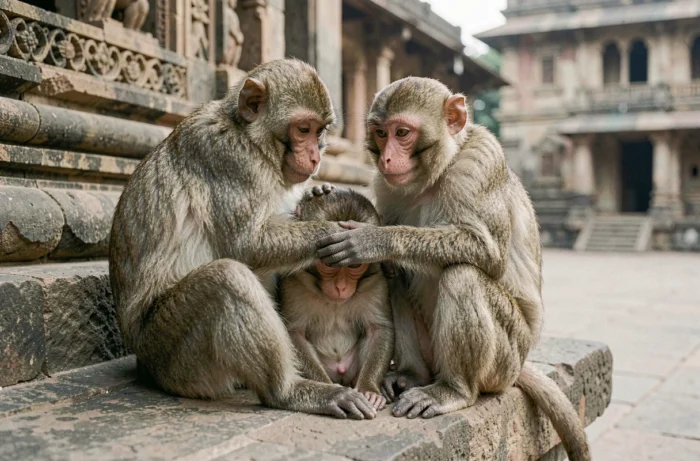
Rhesus macaque or stump-tailed macaque: how to tell them apart in the field
Relying on the red color of the rump alone can lead to misidentification. Here are the practical features that help distinguish these two species:
- The tail: The rhesus macaque has a clearly visible, medium-length tail. The stump-tailed macaque has a vestigial tail just a few centimeters long, often invisible in photos
- The face: The stump-tailed macaque has a bare, red, wrinkled face. The rhesus macaque has a lighter, pinkish face with less prominent cheeks
- The coat: Brownish gray in the rhesus macaque, dark brown to almost black in the stump-tailed macaque
- Geographic range: The rhesus macaque occupies much of South and East Asia, while the stump-tailed macaque lives mainly in the forests of Southeast Asia
Cross-checking at least three of these features makes for a reliable identification. A single trait, even one as striking as the red color, is not enough.
Why the rump turns red: biology and social signals
A red rump is not just decorative. In macaques, it serves as a direct form of communication related to reproduction and social status.
In female rhesus macaques, the color and size of the genital skin change throughout the ovarian cycle. This visual signal tells males when the female is fertile. The intensity of the red varies between individuals and with hormonal conditions.
Redness can also signal social rank, not just sexual maturity.
In stump-tailed macaques, the face and rump are permanently red, but the color intensifies during the breeding season. The difference from baboons lies in the extent of the swelling: macaques develop moderate swelling, while baboons can develop sometimes spectacular protrusions.
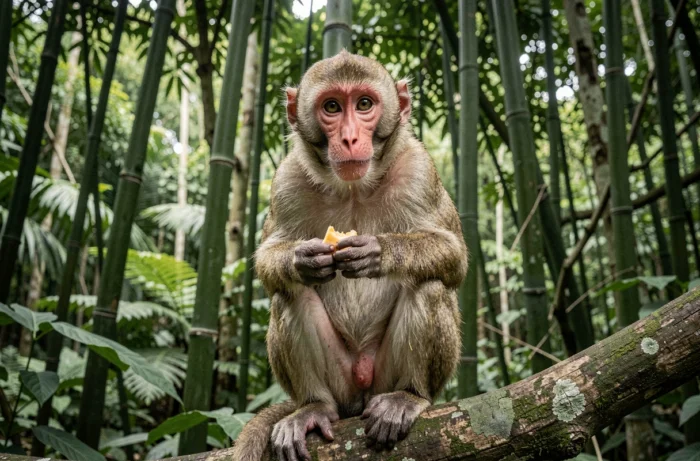
Seasonal reproduction in rhesus macaques: what field observations show
Macaques are often thought to reproduce year-round. Observations of free-ranging rhesus macaque populations in Puerto Rico offer a more nuanced picture. Mating and births were concentrated in certain periods, probably in connection with changes in vegetation and rainfall.
This seasonality directly affects coloration. Females have redder rumps during the breeding season, after which the color fades. So seeing a macaque with a less colorful rump does not mean it belongs to another species: the season in which the animal is observed changes its appearance.
This local variation makes identification from videos or photos without context more difficult. Without knowing the date, location and sex of the animal, identifying its species remains uncertain.
Conservation status of the stump-tailed macaque
The rhesus macaque remains widespread and is not considered a major conservation concern. The situation is different for the stump-tailed macaque (Macaca arctoides), which is classified as vulnerable according to available secondary sources. The exact date of this assessment has not been confirmed in the accessible data, and the IUCN Red List should be checked before citing this status as definitive.
The threats facing the stump-tailed macaque are typical of a forest-dwelling primate in Southeast Asia: habitat loss due to deforestation, forest fragmentation and occasional capture. Its naturally elusive behavior and smaller population make it less visible than the rhesus macaque, which partly explains why it remains little known to the general public.
The next time a video shows a “red-bottomed monkey,” looking at its tail, face and filming location will tell you more than the color of its rump. It’s this combination of details that separates a viral anecdote from a genuinely useful observation.