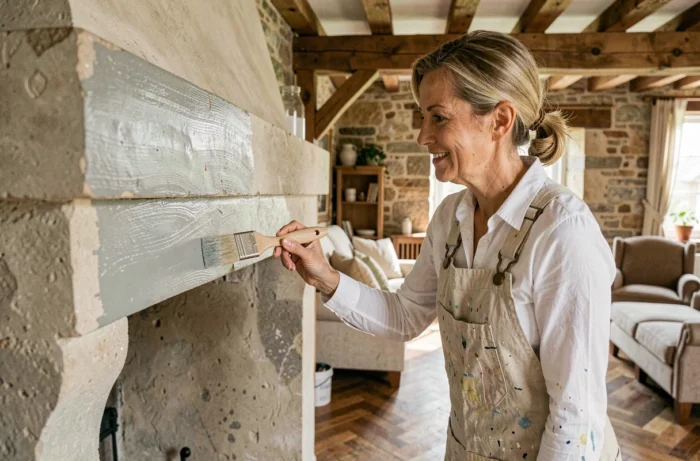
The chimney hood often occupies a significant wall space in a living room. When its surface ages, the temptation to repaint it is strong. The choice of paint for the chimney hood is not just a matter of color or finish: it depends on the material of the substrate, the actual distance from the fire, and the thermal behavior of the area to be treated.
Mineral or metallic substrate: the distinction that conditions the entire project
Competitors often treat the chimney as a homogeneous set. The hood, in practice, can be made of plaster, stone, brick, aerated concrete, or, more rarely, metal. Each material requires a different type of product.
A high-temperature paint formulated for steel or cast iron is not suitable for a porous mineral substrate. The silicone resins that make up these products are designed to adhere to abraded metals, not to plaster or stone. If you’re looking to find out which paint for chimney hood to apply at home, the first step is to identify the exact nature of the substrate.
On a plaster or stone hood, a special façade acrylic paint offers good adhesion and sufficient resistance to moderate temperature variations. On a metal covering, you need to switch to a high-temperature paint compatible with metal, after careful sanding.
Thermal resistance of the paint: peak temperature and continuous exposure
Product data sheets display impressive thermal resistances, sometimes claimed to be up to 900 °C. This figure most often corresponds to a peak temperature, not to continuous exposure. The distinction between thermal peak and prolonged heat is rarely clarified in comparisons, and yet it is the primary cause of blisters or peeling after a few fires.
The hood, unless in an atypical configuration, is not in direct contact with the flames. It receives indirect radiation and residual heat that rarely exceeds a few hundred degrees on the surface. For this specific area, a quality acrylic paint is sufficient in the majority of cases.
The areas close to the fire (shelf above the hearth, base) are another matter. The confusion arises from the fact that many guides recommend high-temperature paint for the entire chimney, without distinguishing the hood from the hearth. The thermal oversizing of the product does not improve the finish; it can even degrade it: some high-temperature paints offer a very limited choice of shades and a less smooth finish than classic acrylics.
Preparation of the hood before painting: soot as an adhesion problem
The preparation of the substrate is the most underestimated factor. On a chimney hood used for several years, soot does not just dirty: it forms a greasy film that prevents any lasting adhesion of the paint.
- Degrease the surface with an appropriate product (diluted caustic soda or special soot cleaner) to eliminate carbon residues, not just visible dust.
- Remove friable particles by brushing or scraping, especially on old stone or brick substrates where the original coating may detach in plates.
- Apply a binding primer on porous substrates (plaster, stone, aerated concrete) to uniform absorption and avoid differences in shade after drying.
- Lightly sand the metal surfaces to create a mechanical grip before applying the high-temperature paint.
Treating soot as an adhesion problem and not just as simple dirt changes the final result. A superficial cleaning with a damp cloth is not enough: the residual greasy layer causes localized peeling within weeks.
Primer or undercoat: a choice that depends on porosity
On very porous old plaster, a binding primer penetrates and consolidates the substrate before painting. On less porous stone or a smooth coating, a classic bonding undercoat does the job. Not applying a primer on a porous substrate exposes you to visible variations in appearance from the very first coat of finish.

Gradual reheating: a technical step often overlooked
Once the paint is applied and dry to the touch, the temptation to light a fire is immediate. Field reports show that this haste is a frequent source of early degradation.
The gradual reheating is an integral part of the painting system. Some formulations require complete drying for several days, followed by a gradual increase in temperature (small short fires, then more sustained fires) to allow the paint film to stabilize. Directly relighting an intense fire can cause micro-cracks in the coating, even on a properly chosen product.
Field reports vary on the exact drying time before the first heating: technical data sheets generally announce several days, but actual conditions (ambient humidity, room ventilation, layer thickness) modify this timeframe. It is better to extend the wait than to shorten it.
Color and finish for a chimney hood: what ages well
The aesthetic choice depends on the style of the living room and the material of the hood. Here are some concrete guidelines:
- Light shades (off-white, light gray, stone beige) visually enlarge the room and match most decors, but reveal more residual soot marks if the hearth is not perfectly airtight.
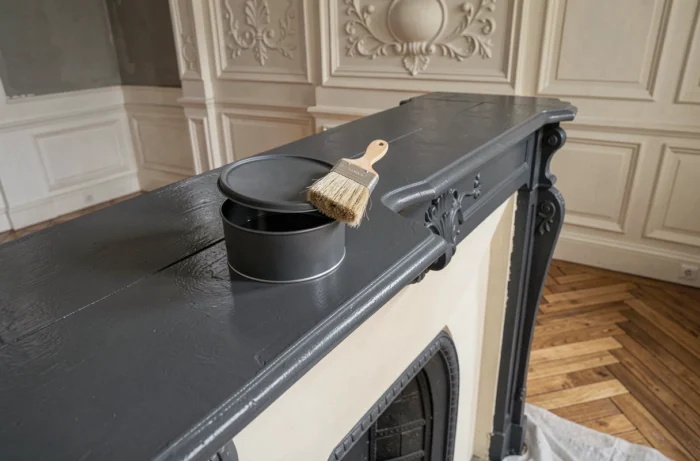
- Dark shades (anthracite, matte black, slate gray) better hide dirt and give a contemporary style to a rustic chimney; however, they absorb light in small living rooms.
- The matte finish is the most common on stone or plaster hoods: it hides the irregularities of the substrate. The satin finish makes maintenance easier but highlights every surface defect.
On a rustic stone chimney, a matte finish in a natural tone remains the most durable choice from an aesthetic point of view. Fashion trends come and go, a well-applied neutral tone withstands the years.
Updating a chimney hood relies less on the price of the paint can than on the suitability between the product, the substrate, and the application method. An honest diagnosis of the material and surface condition avoids most disappointments, much more surely than a high-end product applied on a poorly prepared surface.