
Fitness encompasses all physical activities aimed at improving the body’s capabilities: strength, endurance, flexibility, coordination. Unlike pure weightlifting, which focuses on gaining mass, fitness combines several physical qualities in a single practice. This versatility makes it a direct lever for improving overall fitness, provided that sessions are structured around clear physiological principles.
Micro-fitness sessions: breaking down effort to sustain over time
The main challenge of fitness lies not in the choice of exercises, but in consistency. A study conducted at City, University of London in 2026 showed that setting micro-goals (two minutes of movement rather than a long session) increases total exercise time and facilitates the formation of sports habits.
This principle of breaking down physical activity changes the approach to a program. Instead of reserving a single time slot in the week, spreading short sequences of exercises throughout the day produces measurable cumulative results.
Several formats allow for exploiting this lever, and resources like the fitness section of Bonjour Sportif detail short routines suitable for different levels.
A meta-analysis published in 2026 in the European Journal of Preventive Cardiology confirms that interrupting sitting time with very short bursts of activity (a few minutes of walking or light movement) has significant effects on metabolic and cardiovascular markers, even in the short term. The minimum effective duration is therefore much lower than what most programs suggest.
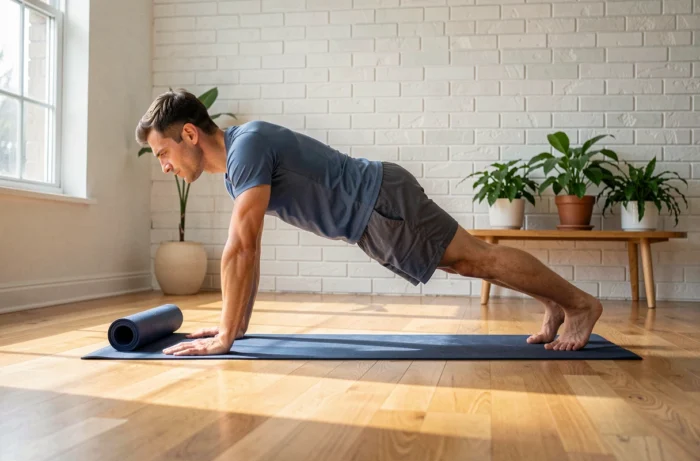
Bodyweight strength exercises: the foundation of fitness
Bodyweight strength training remains the cornerstone of fitness. It engages several muscle groups simultaneously, develops joint stability, and requires no equipment.
Squats, push-ups, and planks: three fundamental movements
The squat works the quadriceps, glutes, and hamstrings. It is the most functional movement for the lower body: each leg bend replicates a daily action.
Push-ups engage the chest, shoulders, and triceps. Varying hand spacing allows for shifting the effort from one muscle group to another.
The plank (front plank) activates the deep trunk muscles. Holding the position for twenty to forty seconds per set is sufficient to strengthen the abdominal core without overloading the back.
Structuring sets according to your level
To progress in fitness, adapting the volume of work to the level is crucial:
- Beginner: two to three sets per exercise, with rest time equal to effort time. The goal is to learn the movement before increasing intensity.
- Intermediate: three to four sets, gradually reducing rest between each set to enhance muscular endurance.
- Advanced: integrate variations (one-legged squats, declined push-ups, dynamic planks) and work in circuits to combine strength and cardio.
Progression comes from increasing volume or difficulty, not from multiplying exercises. It is better to master three movements deeply than to skim over eight different variations each week.
Cardio training and fitness: choosing the right format
Cardiovascular work complements strength training by improving the heart and lungs’ ability to supply oxygen to active muscles. Two formats coexist in fitness, and their choice depends on the targeted goal.
Continuous cardio or interval training
Continuous cardio (brisk walking, cycling, moderate pace running) develops base endurance. It is suitable for beginners and for active recovery between intense sessions.
Interval training alternates between phases of sustained effort and recovery phases. This format increases post-exercise calorie expenditure and engages the cardiovascular system more in less time.
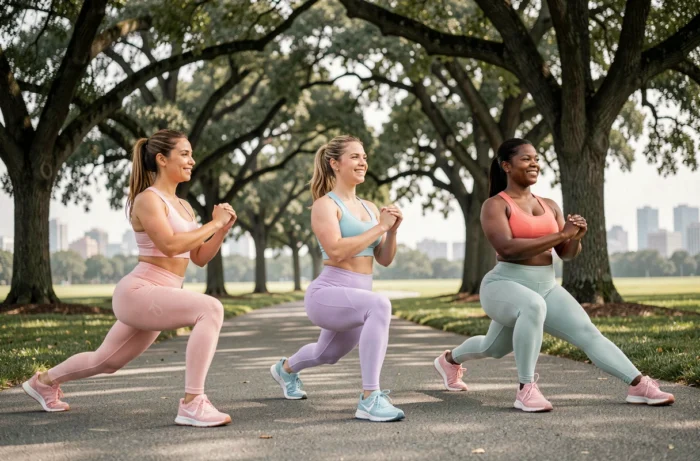
In practice, combining both formats over the week yields better results than repeating a single format. Two sessions of continuous cardio and one session of intervals provide a coherent starting point for most practitioners.
Recovery and stretching: the often underestimated factor in fitness
Physical progression does not occur during effort, but during recovery. Muscle fibers repair and strengthen at rest, provided they are given sufficient time between two demands on the same group.
Stretching at the end of a session aims to restore joint mobility, not to prevent soreness (a link that research has not robustly confirmed). Spending a few minutes on static stretches of the major muscles worked promotes long-term range of motion.
- Stretch the hamstrings and quadriceps after a lower body-focused session.
- Mobilize the shoulders and chest after push-up or press work.
- Include a sequence of deep breathing to gradually lower the heart rate.
Spacing intense sessions by at least one full day on the same muscle group remains the most reliable recommendation to avoid overtraining and maintain steady progression.
Fitness produces tangible results when consistency takes precedence over occasional intensity. A few minutes of activity spread throughout the day count as much as a long weekly session. The best program is the one you stick to over time, not the one that looks impressive on paper.