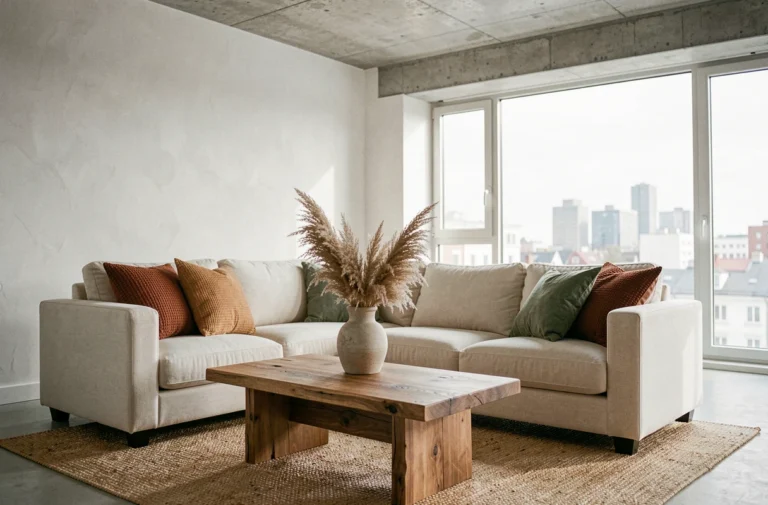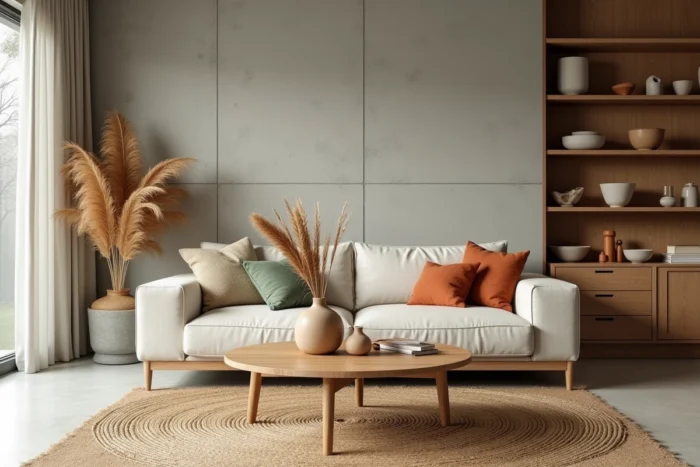
Interior decoration in 2026 is structured around three axes: a return to raw materials, more immersive color palettes, and a furniture approach focused on sustainability. These trends are not fleeting fashions. They reflect a change in the way living spaces are designed, where physiological comfort takes precedence over decorative accumulation.
Color Palettes 2026: Mocha Mousse and Transformative Teal
Each year, international color standards set a course for paint, textile, and furniture manufacturers. In 2026, two shades structure the collections.
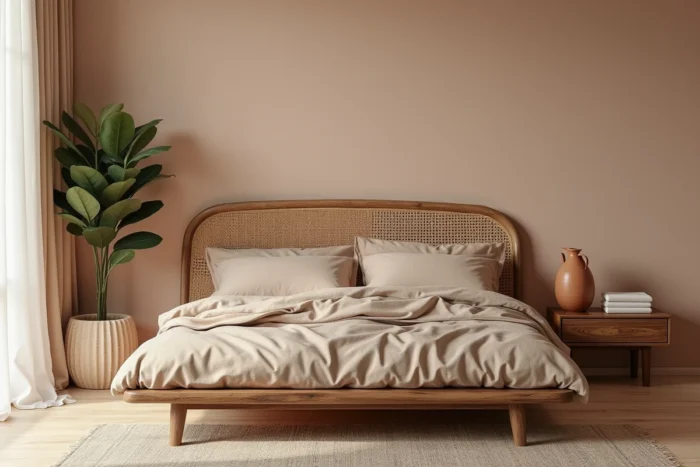
Pantone has designated Mocha Mousse, a soft milky brown, as the key color. This warm tone works well as a wall flat or as an accent on textile furniture. It integrates into contemporary wall paint ranges and gradually replaces the cool grays that have dominated for several years.
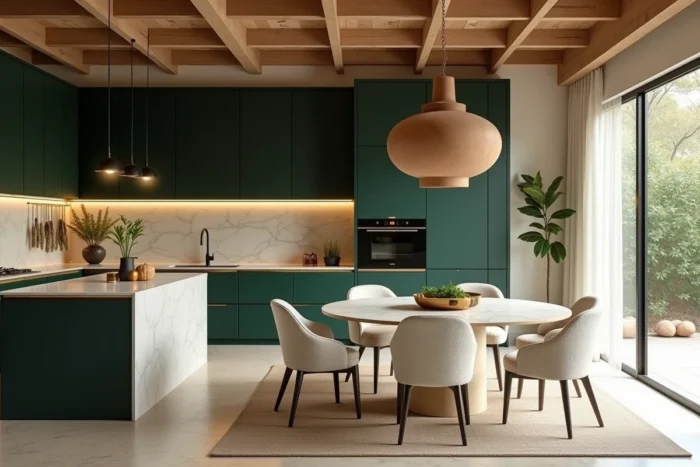
On its part, WGSN in partnership with Coloro positions Transformative Teal as a reference for immersive interiors. This deep blue-green adds a calming dimension to living rooms or bedrooms. The combination of these two shades, one earthy and the other aquatic, offers a coherent foundation for composing an interior palette without resorting to aggressive contrasts.
Beyond these two benchmarks, the 2026 color charts favor muted tones: sage green, muted terracotta, navy blue. Saturated and primary colors are receding in favor of pigments that evoke natural materials. To delve deeper into these associations and find concrete ideas, the resources on interior decoration on La Maison Info detail combinations by room and style.
Biophilic Decoration: Beyond the Green Plant on a Shelf
The term biophilic decoration refers to the systematic integration of living elements and references to nature within an interior space. Maximized natural light, plants, organic materials, and views of the outside are its pillars. The difference from a simple plant touch lies in the intention: it’s not about adding a ficus in a corner, but rethinking the flow of light and the choice of surfaces.
This approach has seen the strongest growth among decoration trends since 2024, particularly in urban apartments. The reason is documented: occupants seek a measurable effect on sleep and stress reduction, not just an aesthetic outcome.
In practical terms, biophilic decoration translates into several choices:
- Wall coverings in raw materials (reconstituted stone, lime plaster, light wood) that replace smooth and uniform finishes
- Lighting fixtures made from natural fibers (rattan, woven linen) that diffuse soft rather than directional light
- A layout that preserves sources of natural light, avoiding tall furniture in front of windows
- The use of dense groups of evergreen plants rather than isolated specimens
Bamboo, hemp, and linen are now found in details (cushions, curtains, rugs) as well as in structural furniture.
Slow Deco and Sustainable Furniture: Buy Less, Choose Better
Slow deco is based on a simple principle: prioritize durable and repairable furniture pieces over collections renewed each season. This movement counters the disposable decoration popularized by certain low-cost brands.
In practice, slow deco favors solid wood, traditional joinery (mortise and tenon, dowels), and finishes that age well over time. An untreated oak piece ages better than a melamine panel, and its cost over ten years often proves to be lower.
The second-hand market and vintage furniture support this trend. Pieces from the 1960s and 1970s, particularly bentwood seating and low Scandinavian buffets, are found in contemporary interiors. The combination of a thrifted piece with new elements creates a visual contrast that fully coordinated interiors do not produce.
Wall Textures and Painting Techniques: Limewash and Natural Plasters
Smooth, monochrome walls are losing ground to textured finishes. Two techniques stand out this year.
Limewash (lime effect paint) produces a cloudy, slightly irregular finish that captures light differently depending on the time of day. When applied to an entire wall, it adds depth without resorting to wallpaper. Limewash works particularly well with earthy shades like Mocha Mousse or rosy beiges.
Natural plasters, made from clay or air lime, offer an alternative to acrylic paints. Their grainy texture absorbs sound and partially regulates ambient humidity, making them a functional as well as aesthetic choice. These plasters require manual application, often in two coats, and their artisanal finish varies slightly from one wall to another.
Colour-drenching, a technique that involves applying the same shade to walls, ceiling, and woodwork, is also gaining traction. The enveloping effect obtained transforms an ordinary room into an immersive space, provided a sufficiently soft color is chosen to avoid overwhelming the volume.
Modular Furniture and Custom Sofas: Adapting Space Daily
Modular sofas are among the most sought-after pieces this year. Their principle is based on independent modules (seat, chaise longue, armrest) that can be reconfigured according to needs: reception, movie night, reading space.
This format addresses a real constraint in urban housing where average square footage is decreasing. A modular sofa replaces both a traditional sofa and additional seating, freeing up floor space.
Open and streamlined shelves complement this adaptability logic. They serve both as storage and decorative support, replacing closed bookshelves that visually weigh down small rooms. Modularity becomes a selection criterion as decisive as material or color.
The common thread of these 2026 trends can be summed up in one word: coherence. A color palette designed around two or three tones, materials that age well, furniture that adapts to real space. The most successful interiors this year will not be the most decorated, but those where each element serves a specific function without competing visually with the others.