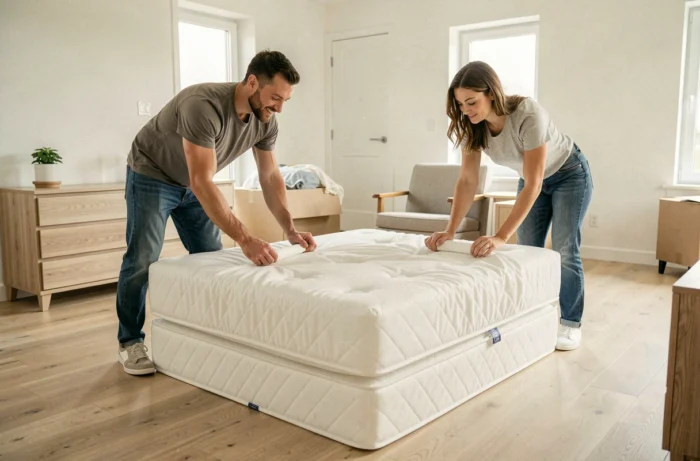
The folding of a mattress during transport involves mechanical stresses that most moving guides underestimate. Depending on the core technology, the duration of compression, and the angle of folding, the consequences on the internal structure range from reversible deformation to a permanent loss of support. Here, we detail the technical parameters that determine whether this handling remains acceptable or poses a real structural risk.
Mechanical Stresses of Folding According to the Mattress Core
The answer to the question of folding first depends on the internal composition. A mattress is not a homogeneous block: each technology reacts differently to forced bending.
Pocket spring mattresses should never be folded. Bending deforms the coils individually, creates weak points in the steel wire, and can cause a permanent misalignment of the springs relative to their textile cover. The result: localized sagging areas that appear within the first nights after transport.
High-resilience polyurethane foams tolerate brief folding. Their cellular structure returns to its original shape as long as the compression does not exceed a few hours. Beyond that, the cell walls begin to break, which irreversibly reduces the support capacity.
Memory foam (viscoelastic) handles rolling better than sharp folding. A fold creates a sharp angle that concentrates mechanical stress on a narrow line, whereas rolling distributes the deformation over the entire surface. The question is whether folding a mattress for transport truly compromises its longevity. We systematically recommend rolling for this type of core.
Latex, whether natural or synthetic, has high elasticity but low tolerance to marked folds. Prolonged folding can crack the internal cellular structure without visible signs on the surface.

Duration of Compression: The Critical Threshold for Mattress Lifespan
The most underestimated variable in mattress transport is not the folding method, but the time spent in a compressed position. Manufacturers who deliver vacuum-packed rolled mattresses use industrial machines calibrated to compress the core under precise temperature and humidity conditions. A homemade folding does not replicate these conditions.
In practice, a few hours of folding do not compromise the structure of a good-density polyurethane foam. Exceeding a full day increases the risk of residual deformation. For a memory foam mattress, the tolerance threshold is comparable, provided that the ambient temperature remains moderate (heat accelerates the plasticity of the foam and worsens deformations).
Industrial Compression and Home Folding: Two Distinct Realities
When a mattress arrives rolled in its box, it has been compressed in the factory within a controlled timeframe, with plastic film maintaining uniform pressure. A home folding with straps creates localized pressure points, exactly where the mattress deteriorates first. The comparison between the two methods makes no technical sense.
Another point that public content often overlooks: some manufacturers specify in their warranty conditions that any compression handling performed outside the factory may void the coverage. Checking warranty clauses before folding a mattress avoids unpleasant surprises in case of a subsequent claim.
Vertical or Flat Transport: Concrete Alternatives to Folding
For most bedding technologies, transport without folding remains the best method to preserve the internal structure. Two positions work well:
- Vertical transport, on edge, pressed against a wall of the vehicle and strapped. This position avoids any crushing of the core and is suitable for both spring mattresses and foams. The mattress should not bear the weight of other objects.
- Flat transport, placed on the floor of the truck, without any load on top. Suitable for all types of mattresses, but requires a vehicle long enough to avoid forcing a curve.
- Tight rolling for thin foams or mattress toppers: roll the mattress onto itself with textile straps, avoiding metal ties that create imprints. Rolling is preferable to folding for memory foam cores.
In all cases, a protective cover (thick plastic or waterproof fabric) protects against dust, moisture, and friction during the move. This is not just an aesthetic detail: a mattress exposed to moisture during transport can develop internal mold within weeks.
Recovery After Transport: What Happens in the First Hours
A compressed or folded mattress must be unpacked and laid flat immediately after transport. This point is agreed upon by manufacturers, and for good reason: each additional hour in a constrained position worsens the risk of residual deformation.
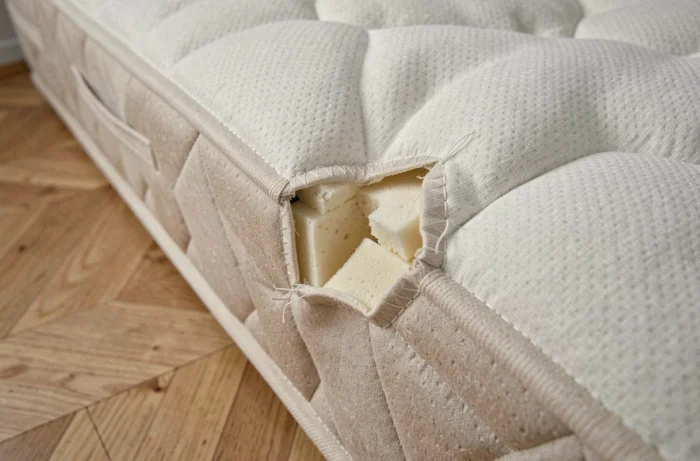
Once laid flat on its bed base, the mattress needs time to regain its original dimensions. Polyurethane foams generally recover within a few hours. Viscoelastic foams may require a full day, sometimes longer in a cool environment. Latex regains its shape more quickly due to its natural elasticity.
Signs of Post-Transport Deformation
After the recovery phase, inspect the mattress by running your hand over the entire surface. An area that remains lower than the rest of the surface indicates a deformation of the core. If this area persists after a few days of normal use, the damage is likely permanent.
A localized dip at the fold line is the most common sign. On a spring mattress, an unusual metallic noise when pressed indicates that coils have been deformed during transport.
Foldable Mattresses and Standard Mattresses: Do Not Confuse Uses
Mattresses designed to be folded (futons, guest mattresses, van conversions) incorporate textile hinges or cuts in the core that allow for repeated folding without damage. A standard bedding mattress does not have this design and should not be treated as a foldable product.
The confusion often arises from the marketing of rolled compressed mattresses, delivered in boxes. The fact that a mattress was rolled once in the factory does not mean it can withstand being folded regularly. The initial compression is a one-time, calibrated event that does not predict the product’s tolerance to repeated handling.
For a move, strapped vertical transport or flat transport without load remains the safest method, regardless of the core type. If folding is the only option (narrow stairwell, too short vehicle), limit the duration to a few hours and prefer rolling over sharp folding, completely excluding this method for spring mattresses.