Choosing a dental clinic abroad for extensive care (implants, bridges, complete rehabilitation) requires checking elements that price alone does not reveal. Clinic licensing, the practitioner’s registration on a national register, traceability of implants, and follow-up protocols after returning: these criteria distinguish reliable facilities from platforms that provide a quote based on two blurry photos.
Remote quotes and actual clinical examination: what distinguishes a serious clinic
The first filter has nothing to do with the destination or the price. It concerns how the treatment plan is established. A clinic that offers a definitive quote based on selfies or panoramic X-rays sent by email does not operate like a medical office. It operates like a commercial service.
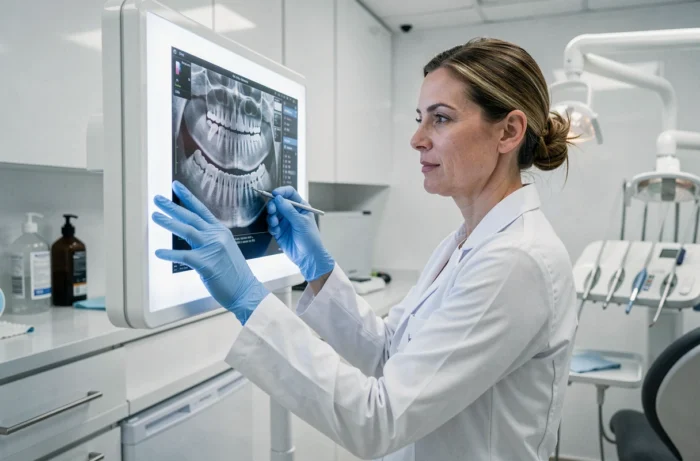
A reliable treatment plan stems from a clinical examination, recent X-rays (panoramic and, for implants, cone beam 3D), and direct communication with the practitioner who will perform the procedure. A serious quote always relies on an actual examination, not on photos. If the clinic refuses to detail the diagnostic steps before your visit, or if the quote arrives within twenty-four hours without questions about your medical history, the signal is clear.
When searching for a dental clinic abroad, ensure that the facility offers a preliminary consultation (via video or in person) with the dentist who will operate, and not with a coordinator without medical training.
Verification of practitioners and licenses: registers to consult country by country
Asking for the full name of the dentist and their professional registration number should be a reflex. Each European country has a public register of practitioners authorized to practice.
| Country | Professional Register | Verifiable Information |
|---|---|---|
| Hungary | ÁEEK (national health register) | Registration number, specialty |
| Romania | College of Dentists of Romania | Active status, possible sanctions |
| Turkey | Turkish Ministry of Health | Clinic license, practitioner’s authorization |
| Spain | Official College of Dentists (COEM or regional equivalent) | College number, specialization |
Checking the practitioner’s registration on the relevant country’s register helps eliminate facilities where unlicensed dentists operate or whose licenses have been suspended. The clinic must also have a practice authorization issued by the local health authority. Request it in writing before confirming an appointment.
Traceability of dental implants: brands, documentation, and written warranty
Competitors often list the cheapest destinations without addressing this point: the brand of the implant and its documentation condition long-term follow-up. An implant placed in Budapest or Istanbul will need to be maintained, adjusted, or replaced by your dentist in France. Without a technical sheet, lot reference, and implant passport, the French practitioner works blindly.
Before validating a quote, ask these questions:
- What brand of implant will be used, and is this brand distributed in France (Straumann, Nobel Biocare, Osstem, for example)?
- Does the clinic provide an implant passport with the lot number, abutment reference, and placement date?
- Is there a written warranty on the implant and the prosthesis, and what conditions invalidate it?
A clinic that refuses to disclose the exact brand of the implant or uses generic components without traceability exposes the patient to complications without recourse. In contrast, facilities that systematically provide a complete file to the patient facilitate continuity of care once back home.
Post-operative follow-up protocol after returning to France
Follow-up does not stop at the clinic’s exit. For implants, the osseointegration phase lasts several months. Complications (infection, peri-implantitis, loosening of the abutment) can occur weeks after the procedure.
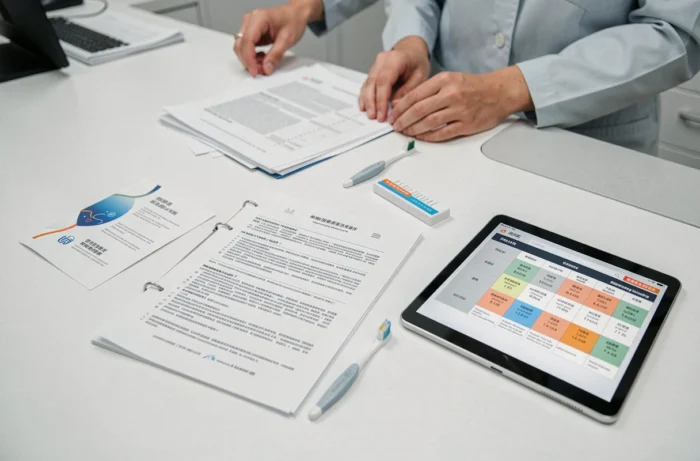
A clear follow-up protocol with a designated contact in case of complications is a quality marker that many patients overlook at the time of choice. Check if the clinic offers a contact person reachable after your return, if it provides an operative report usable by your dentist in France, and if it has a schedule for follow-ups (follow-up X-rays at three months, six months, one year).
Some clinics in Hungary or Romania include a follow-up appointment in the initial package, covering travel for the placement of the definitive prosthesis. Others charge for each additional consultation. Comparing packages based on the total cost of the care journey, not on the unit price of the implant, radically changes the ranking of offers.
Complex cases: what a quote seller cannot assess remotely
A complete rehabilitation (All-on-4, bone graft, sinus lift) does not fall under the same level of expertise as a single crown placement. For complex cases, the choice of clinic relies on additional criteria that referral platforms generally do not verify.
- Does the practitioner have a specialization in oral surgery or implantology, certified by an additional diploma?
- Does the clinic have an operating room that meets standards (and not just a regular chair) for procedures under sedation?
- Are similar cases to yours documented in the clinical portfolio, with before/after X-rays and documented follow-up duration?
A complex case requires verified technical facilities and a specialized surgeon. If the clinic cannot prove its experience with your specific type of treatment, it is not suitable, regardless of the displayed price.
The choice of a dental clinic abroad hinges on the transparency of the diagnosis, the verifiability of qualifications, and the continuity of follow-up. A low quote without an implant passport, without a verifiable register, and without a post-operative protocol often costs more to correct in France than the initial treatment.