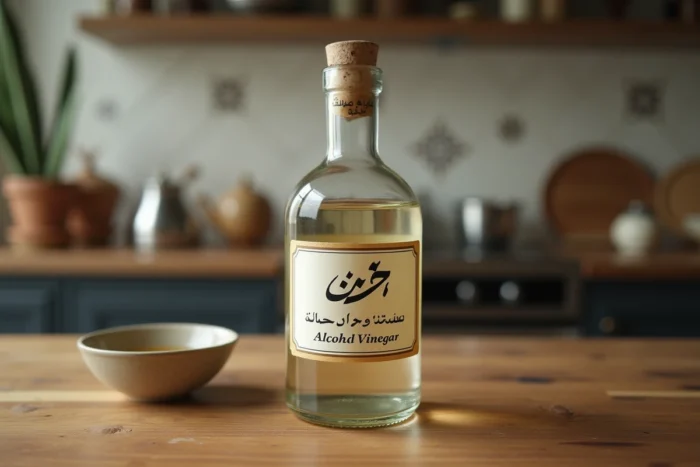
Alcohol vinegar poses a problem of Islamic legal qualification that most articles address from the perspective of the hadith of Jâbir without ever discussing the analytical aspect. The central question does not concern the fermentative origin of the product, but rather its final chemical composition and the transformation mechanism that fiqh refers to as istihalah.
Residual ethanol in alcohol vinegar: what industrial analyses show
Alcohol vinegar produced by continuous acetification generally contains no detectable ethanol according to standard control methods. The finished product is composed almost exclusively of water and acetic acid, with residual ethanol falling below the analytical detection threshold.
This technical data changes the nature of the debate. When a scholar rules on vinegar, they evaluate a liquid that no longer possesses any intoxicating power, nor even measurable traces of the prohibited substance. The absence of measurable ethanol in the finished product radically distinguishes alcohol vinegar from a dish cooked with wine, where alcohol residues persist depending on the cooking duration.
Several contemporary fatwa instances have clarified that the key to the judgment is not the alcohol content indicated on the source bottle, but the total absence of intoxicating power in the finished product. This nuance, rarely articulated in popular articles, is nonetheless the pivot of permissive opinions.
The question of whether alcohol vinegar is halal according to Islam finds here a first factual element of response, even before delving into the details of legal positions.
Istihalah and halal status of vinegar: the rule of transformation in fiqh

Istihalah refers in Islamic jurisprudence to the complete change of nature of a substance, resulting in the modification of its legal status. The principle is based on a simple logic: if an impure material (najis) transforms into a material whose properties (taste, smell, color, effect) are entirely different, the new product receives its own status.
Vinegar is the classic example cited by fuqaha to illustrate this rule. Grape juice, permissible, becomes wine, prohibited. Wine, through acetic fermentation, becomes vinegar. Vinegar is a new substance, distinct from wine in its chemical composition and effects.
All four legal schools (madhahib) recognize the validity of istihalah for naturally formed vinegar. The divergence lies in a specific case: deliberate transformation.
Natural transformation and induced transformation: where the divergence lies
When wine transforms into vinegar on its own, without human intervention, scholars unanimously agree on the permissibility of the obtained product. The hadith reported by Muslim, where the Prophet (peace and blessings be upon him) qualifies vinegar as a “good condiment” (ni’ma al-udm al-khall), serves as the textual foundation for this consensus.
The divergence appears when an operator deliberately induces the transformation, by adding an acetifying agent or through controlled exposure. Here we observe three main positions:
- The Hanafi school considers vinegar permissible in all cases, whether the transformation is spontaneous or induced, because the change of nature nullifies the previous status of the substance, regardless of the cause of this change.
- The Hanbali school, in one of its opinions, prohibits the voluntary transformation of wine into vinegar and judges the obtained product as illicit, relying on the hadith of Anas ibn Malik reported by Muslim, where the Prophet allegedly refused to allow wine to be transformed into vinegar.
- The Maliki and Shafi’i schools present nuanced internal positions, with some of their jurists aligning with the Hanafi opinion when the transformation is complete and verifiable.
Industrial alcohol vinegar: which madhab applies
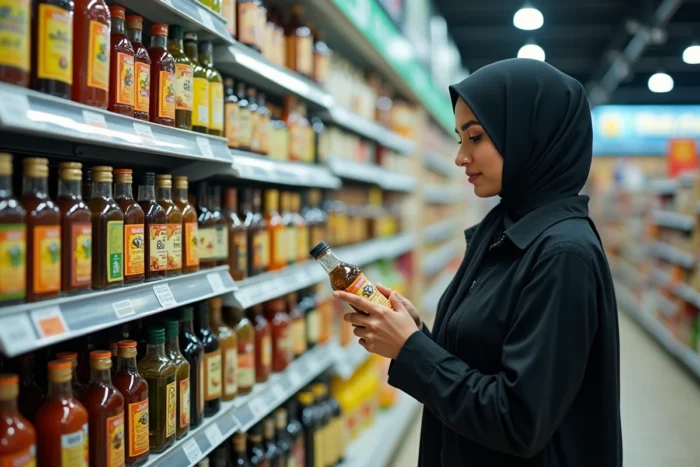
The alcohol vinegar sold in France is not produced from wine in the strict sense. It is made from agricultural-origin ethanol (beet, grains) subjected to industrial acetification. This process raises a question that classical texts did not directly address: does technical ethanol, not intended for drinking, have the same status as khamr?
Halal certification authorities today distinguish between ethanol intended for drinking (khamr) and technical or fermentative ethanol used as a process step. This distinction directly impacts the status of alcohol vinegar, as if the raw material is not considered khamr, the question of istihalah does not even arise.
For the Hanafi school, industrial alcohol vinegar is permissible without reservation: the raw material is not wine, and the finished product contains neither detectable ethanol nor intoxicating power. The most restrictive opinions, based on the prohibition of inducing the transformation of wine, lose part of their foundation here, since the starting point is not wine.
Hadith of Jâbir and hadith of Anas: how scholars articulate two seemingly contradictory texts
The hadith of Jâbir ibn Abdillah, reported in Sahih Muslim, is a text of praise: the Prophet (peace and blessings be upon him) consumes vinegar and positively qualifies it. The hadith of Anas ibn Malik, also in Muslim, reports that the Prophet was asked about the possibility of transforming wine from certain orphans into vinegar and responded negatively.
Proponents of the prohibition of voluntary transformation rely on the hadith of Anas to limit the scope of the hadith of Jâbir to only naturally formed vinegar. The Hanafis, on the other hand, interpret the Prophet’s refusal as an encouragement to dispose of the wine rather than to preserve it, without implying the illicitness of the resulting vinegar if the transformation indeed took place.
Neither of the two texts addresses industrial alcohol vinegar as it exists today. Both hadiths concern grape wine vinegar in the context of Medina. The analogy with a product made from beet ethanol falls under contemporary ijtihad, which explains why halal certification bodies have had to produce their own analyses.
Alcohol vinegar and halal certification: criteria retained by contemporary organizations
Certification bodies do not settle for a theoretical legal opinion. They require traceability of the raw material and analysis of the finished product. The criteria retained combine fiqh and analytical science:
- Verification that the source of ethanol is not khamr in the strict sense (wine, beer), but technical ethanol of agricultural origin.
- Analysis of the residual ethanol level in the finished product, which must be undetectable or negligible.
- Confirmation that the manufacturing process leaves no intoxicating compounds in the marketed vinegar.
The Council of Scholars of Indonesia (MUI), for example, incorporates this distinction between ethanol-khamr and process ethanol into its certification criteria. This approach is becoming widespread among major halal bodies, which consider that industrial alcohol vinegar meets the conditions of complete istihalah.
The debate remains open for Muslims who strictly follow the restrictive Hanbali opinion. For the majority of schools and certification bodies, the alcohol vinegar sold in supermarkets is halal, provided that the finished product is free from residual ethanol, which is the standard case in current industrial production.