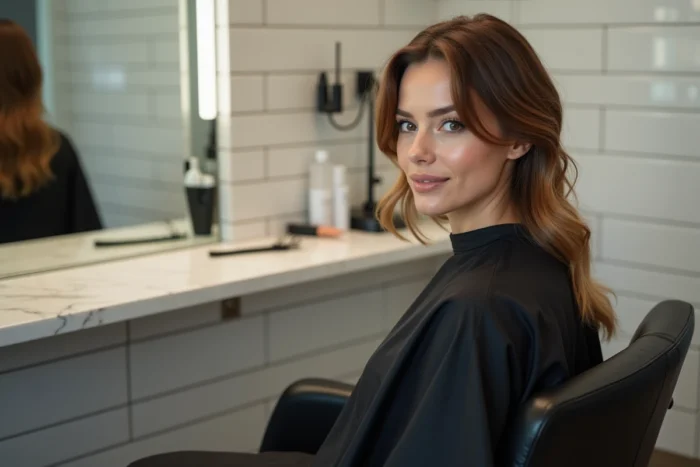
The mullet version 2026 no longer resembles the one from the 1980s. The requested mullet hairstyle in salons has shifted towards precise, textured cuts, often unisex, that vary according to face shape and hair texture. Rather than listing all possible variations, this article compares the most requested styles this year, their technical difficulty level, and their compatibility with different hair types.
Chillet, modern mullet, and wolf cut: comparative table of salon cuts 2026
Three cuts account for the majority of mullet requests in salons this year. Their technical differences are clear, but often misunderstood by clients who arrive with a Pinterest photo without knowing which one they are actually asking for.
| Variant | Front/back contrast | Volume on the sides | Dominant texture | Typical profile |
|---|---|---|---|---|
| Chillet | Low (soft transition) | Little volume, fine layers | Natural movement, polished finish | Straight, wavy, or curly hair |
| Modern mullet | Moderate (marked gradient) | Controlled volume | Sharp texturization, thinning | Oval faces, medium-thick hair |
| Wolf cut | High (very contrasting layers) | Significant volume | Worked curls or waves | Thick, curly hair |
The chillet softens the classic mullet by reducing the contrasts between the top and the nape. Popularized by Jacob Elordi, Jeremy Allen White, or Patrick Schwarzenegger, it leans towards a wearable look for everyday life. The nape remains long, but the layers are fine and the movement on top appears natural.
The modern mullet retains a more pronounced gradient. It works particularly well on oval faces when carefully textured. The wolf cut, on the other hand, maximizes contrast with very marked layers that create volume, especially suited for thick or curly hair.
Several salons are now documenting the 2026 hair trends on Ulta Beauté with photos of actual results, which helps visualize the final look on different hair textures.
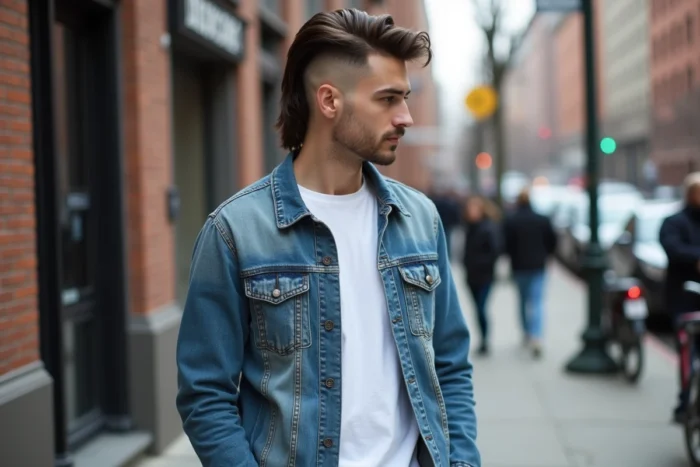
Men’s and women’s mullet in 2026: narrowing technical gaps
The 2026 mullet has become one of the most requested cuts in a unisex version. The same cut can be seen on athletes, content creators, and a wide variety of generational profiles. The distinction between men and women fades in favor of hair texture.
In practice, the cutting technique differs little between a men’s mullet and a women’s mullet of the same length. What changes is the finishing work.
- On fine, straight hair, the stylist favors light thinning at the nape to avoid the “rat tail” effect, regardless of the client’s morphology.
- On thick or curly hair, the layers are more spaced out and the volume is distributed on top to structure the silhouette of the cut.
- On wavy hair, the chillet stands out as the most versatile variant, with a soft gradient that allows the waves to work on their own.
The style is no longer confined to a rock or punk aesthetic. Profiles far removed from this genre are adopting the cut, including people over fifty who request a discreet, textured, and easy-to-maintain modern mullet.
Face shape and choice of mullet variant
Most guides on the mullet hairstyle overlook a parameter that conditions the result: the shape of the face. The same mullet cut can structure an oval face and unbalance a round face if the volume is poorly placed.
Oval face and textured mullet
The oval face remains the most compatible with the mullet in all its forms. The textured mullet with a moderate gradient works without any particular correction. The stylist can focus on texture rather than compensating for proportions.
Round or square face: adjusting the volume
For a round face, volume should remain on top and taper on the sides. The chillet, with its fine layers and low lateral volume, is better suited than a wolf cut that would add width. For a square face, a longer gradient at the nape can visually elongate the silhouette.
The shape of the face determines the variant, not the other way around. Arriving at the salon with a photo without considering one’s morphology remains the primary cause of disappointment with this type of cut.
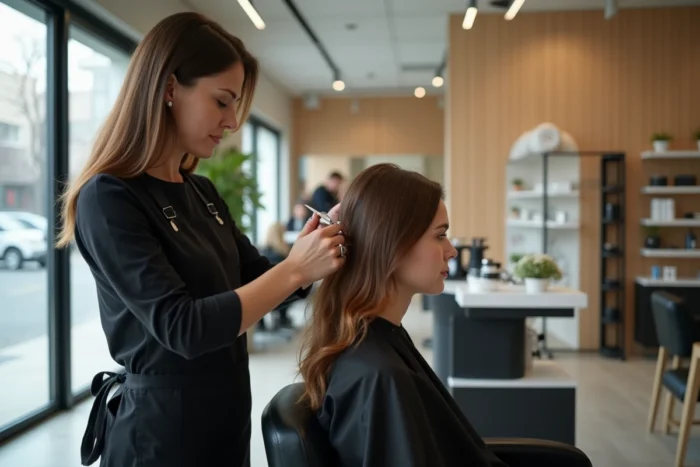
Mullet maintenance in the salon: cutting frequency and suitable products
The mullet requires more regular maintenance than a classic cut. The reason is mechanical: the contrast between short and long areas blurs as hair grows evenly.
For a modern mullet or a chillet, a touch-up every four to six weeks maintains the structure of the gradient. Beyond that, the layers lose their definition and the cut resembles an unintentional in-between.
In terms of daily styling, the load remains light. Texturizing products (salt spray, matte paste) are sufficient to maintain movement on straight or wavy hair. On curly hair, a light leave-in preserves curl definition without weighing down the nape.
The stylist also plays a role at the time of the initial cut: good thinning reduces the need for daily styling. A well-cut mullet should not require more than two minutes of styling in the morning.
The 2026 mullet rests on a technical paradox: the more relaxed the cut appears, the higher the precision of the gradient and texturization must be. It is this work in the salon, not the style chosen on a screen, that makes the difference between a mastered look and a cut that ages poorly in three weeks.