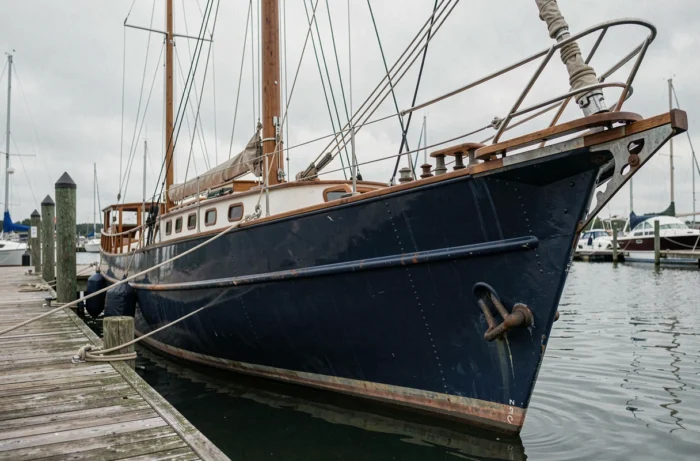
The second-hand steel sailboat market is going through a unique period. On one hand, there is an abundant supply of robust hulls built in the 1980s-1990s, often designed for long voyages. On the other hand, a modified tax framework since 2022 is reshuffling the cards regarding the actual attractiveness of these boats based on their age and length.
TAEMUP Taxation and Old Steel Sailboats: An Underestimated Lever
Since January 1, 2022, the annual tax on personal maritime vessels (TAEMUP) has replaced the former annual registration and navigation fee (DAFN). This change directly affects the cost of owning a second-hand steel sailboat, but most listings do not mention it.
The TAEMUP applies from 7 meters of hull or 22 administrative horsepower, even on a sail-dominant sailboat. It combines a hull length component and an engine power component, with a progressive scale (7-8 m, 8-10 m, 10-12 m, and beyond).
The determining factor for the second-hand buyer: the tax deduction increases significantly with the age of the boat. No reduction exists before 10 years. Between 10 and 25 years, the relief is gradual. Beyond 25 years, the reduction becomes very significant.
A well-maintained steel sailboat aged 30 to 40 years can therefore show a significantly lower annual tax burden than a more recent unit of comparable size. For those looking for a second-hand steel sailboat for sale, this factor weighs as heavily as the purchase price in calculating the actual budget.

Second-Hand Steel Hull: What the Inspection Reveals (or Not)
Steel remains the material of choice for cruising sailboats for a simple reason: its ability to withstand impacts and its reparability in remote ports. A yard equipped with a welding station is sufficient to repair a damaged plate, whereas a composite repair requires more controlled workshop conditions.
But steel has a constant adversary: corrosion. In the second-hand market, the actual condition of the hull cannot be read from listing photos. Two sailboats from the same yard, launched in the same year, can have radically different plate thicknesses depending on the maintenance of sacrificial anodes, the quality of the paint, and the navigation areas.
Key Inspection Points to Prioritize
- The residual thickness of the plates, measured by ultrasound in critical areas (waterline, keel, transom, through-hulls). A recent report with quantified measurements is the most reliable document to assess the remaining structural lifespan.
- The condition of the internal welds, often hidden by insulation or lining. Corrosion repairs frequently start from the inside, where condensation accumulates.
- The cathodic protection system: number, position, and wear condition of the anodes. A boat whose anodes have not been replaced for several seasons indicates approximate maintenance.
Field reports vary on the acceptable age limit of a steel hull. Some sailboats over 40 years old sail without issue with still comfortable plate thicknesses. Others, more recent but poorly protected, show structural weaknesses. The maintenance history takes precedence over the year of construction.
Rigging and Layout: Ketch, Schooner, or Sloop for Offshore Cruising
Second-hand steel sailboats come in several rig types, and this choice directly influences the price, ease of handling, and sailing program.
The ketch, with its two masts, one smaller at the back, remains well represented in the second-hand steel market. It allows for dividing the sail area into smaller units, an advantage for sailing with a reduced crew or for offshore cruising. The schooner, rarer, appeals to enthusiasts of large volumes and traditional rigging.
The sloop, the most common rig on modern sailboats, is also found on steel hulls. It generally offers better performance upwind but requires a more attentive crew as the mainsail area increases with the length of the boat.
The type of rigging also affects the ongoing maintenance budget. A ketch involves two masts, thus two sets of shrouds, two stays, more blocks, and halyards. On a sailboat of 12 to 15 meters, the complete replacement of the standing rigging represents a major expense that should be anticipated from the purchase.
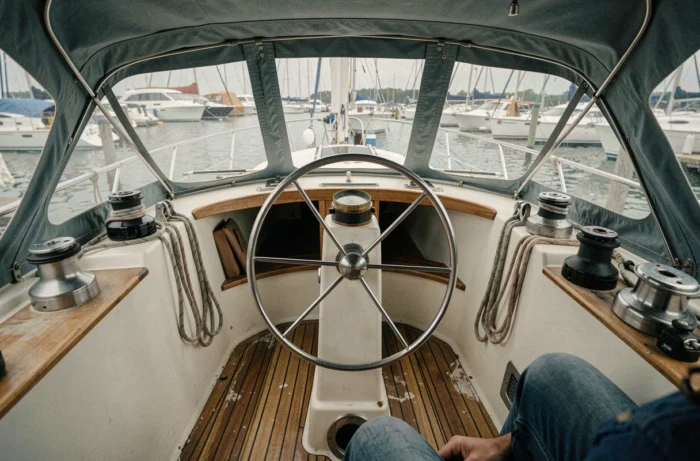
Prices of Second-Hand Steel Sailboats: Looking Beyond the Displayed Amount
Current listings show a very wide price range for steel sailboats, from a few tens of thousands of euros for units of 10-11 meters needing work, to much higher amounts for ready-to-sail cruising boats in the 13-15 meter range.
A low price does not automatically indicate a good deal. The true cost of a second-hand steel sailboat includes the refurbishment of the rigging, hull painting, and replacement of onboard equipment. A boat listed at an attractive price but with original standing rigging, obsolete electronics, and blistering hull paint can easily double in cost before the first outing at sea.
The characteristics that maintain the value of a steel sailboat in the second-hand market are relatively constant:
- A recent ultrasound inspection report with documented plate thicknesses
- Replaced or well-maintained standing rigging, with supporting invoices
- A well-maintained engine with a detailed logbook (hours, oil changes, replaced parts)
- A well-kept interior layout with proper insulation, indicating that the boat has been lived in and maintained
The width and number of cabins also influence the value. A cruising steel sailboat with two or three separate cabins resells better than an open layout, as it corresponds to a family or crew travel program.
Before signing, consulting an independent maritime expert remains the only reliable protection. A well-inspected steel sailboat protects better than an aggressive price negotiation. The cost of the inspection represents a tiny fraction compared to the unpleasant surprises it can reveal.